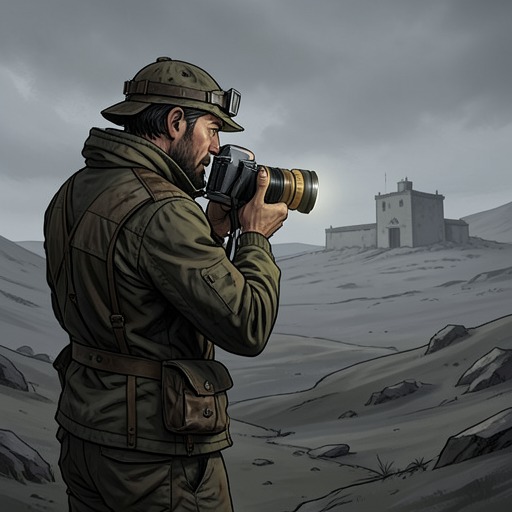
Sergei Gurin
Voices from ChernobylSergei Gurin, identified as a cameraman, enters the Chernobyl disaster as both a witness with a camera and a person whose own senses and assumptions are unsettled by what he sees. In the Chernobyl exclusion zone, the ordinary beauty of flowering trees becomes evidence of an invisible change: the picture looks right, but the blossoms have no smell. That disjunction shapes his understanding of the disaster and, eventually, his decision to film animals rather than people.
Identity and First Perception
Gurin recalls beginning to film apple trees in bloom. Bumblebees moved among the flowers, the gardens were being worked, and the blossoms appeared white and bridal. The camera produced a pretty picture with normal exposure, yet he felt that something was wrong. The missing detail was smell. He first compared his condition to his seventy-four-year-old mother’s loss of smell, only later learning that the body can respond to high radiation doses by blocking the function of certain organs.
He checked the sensation with the two other people present. None of them could smell the apple trees; the lilacs had no scent either. The absence was not visible on film, which made the scene seem unreal to him, like a film set. His camera could preserve the orchard’s appearance but not the sensory break that made it frightening. The discrepancy between a beautiful image and a world that no longer registered normally became one of his first ways of recognizing that something was happening to them.
Exposure, Rumor, and Compulsion
The danger was difficult to grasp because information did not agree. Gurin recalls dosimetrists giving one set of figures and newspapers another. In the absence of reliable understanding, he thought about his young child and wife at home, and wondered why he was there; the possibility of receiving a medal offered little comfort against the prospect that his wife might leave him. Humor, he says, was the only salvation. Jokes could briefly make the situation speakable, even as the landscape continued its ordinary routines.
The wind report sharpened the personal stakes. Newspapers said it was blowing away from the city and Kyiv, but Gurin understood that it was blowing toward Belarus, where he and Yurik had been walking in the forest and gathering cabbage. Back in Minsk, he heard on a bus that a cameraman with two children had died while filming in Chernobyl. At first he wondered whether he knew the man; then the name was corrected from Vitya Gurevich to Sergei Gurin. He walked toward the studio imagining that he might find a memorial to himself there, and absurdly wondered where the personnel department would have obtained his photograph.
The rumor, he reflects, grew from the mismatch between the scale of the catastrophe and the small number of deaths people could initially count. A battle such as Kursk, with thousands dead, was comprehensible in a way that a handful of reported firemen followed by abstractions such as harm lasting for generations, forever, or nothing was not. Rumors filled that gap with images of three-headed birds, chickens pecking foxes to death, and bald hedgehogs. Meanwhile, when the studio needed another cameraman to go to the Chernobyl exclusion zone, colleagues cited an ulcer or vacation. Gurin was told to go because he had already been there and already had children, while the other men were still young. He objected that he might want five or six children; pressure about future salary reviews and a raise accompanied the order.
What Catastrophe Reveals About People
Gurin connects his experience in Chernobyl to earlier filming of people who had been in concentration camps. They tried to avoid meeting one another, and he understood their reluctance to gather and remember shared humiliation. What he encountered in the disaster led him to distrust idealized accounts of how people behave under extreme pressure: humanistic ideals, he concluded, are relative, and people do not necessarily become heroes.
His images of evacuation give that judgment concrete form. A collective-farm chairman wanted two cars to carry his family, clothes, and furniture; the Party organization also demanded a car in the name of fairness. Yet for days there had not been enough vehicles to transport a group from a nursery school. Even two cars could not hold everything, including three-liter cans of jam and pickled vegetables, which Gurin saw being packed the next day. He did not film that scene. He and his companions bought salami and canned food but were afraid to eat it; they carried it around rather than throw it away. For him, catastrophe did not erase ordinary self-interest: people still gossiped, sought favor with their superiors, and tried to save possessions such as a television or an ugly fur coat. The disaster made those habits more visible, not less.
From Human Subjects to Animals
Gurin identifies an old woman unwilling to leave her cat and the scentless apple tree as the experiences that started his change of direction. He later showed his Chernobyl films to children, although some adults objected that the children should not have to see them. The theater filled, and the children asked questions. One shy, stammering boy asked why no one had helped the animals. Gurin says he could not answer. The question stayed with him because, as he saw it, art dwelt on human suffering and love while leaving animals, plants, and other living things outside its field of concern.
He searched for information and heard that someone had proposed evacuating animals along with people in the first months after the accident. The proposal immediately opened into practical and ethical problems: animals above ground might perhaps be moved, but what of insects and worms in the earth, or pigeons and sparrows in the sky? There was no way to give them the information needed to participate in evacuation. For Gurin, the difficulty was also philosophical, calling for a change in human feeling rather than a simple extension of familiar rescue procedures.
Filming the More-than-Human World
Gurin says that he now films only animals and wants to make a film called Hostages. He describes becoming closer to animals, trees, and birds, with the distance between them seeming to narrow. On later visits to the Chernobyl exclusion zone, he films a wild boar emerging from an abandoned human house and then an elk. These are not merely background images for a human story: he wants to see the world through an animal’s eyes.
Other people challenge that choice by pointing to the war in Chechnya. Gurin answers the challenge through the example of Saint Francis, who preached to birds as equals, and considers the possibility that the birds might have spoken to Francis in their own language rather than having been addressed from a human position of superiority. His movement from filming people to filming animals does not resolve the disaster or restore what was lost. It changes the direction of attention: the camera turns toward lives that human accounts of Chernobyl had treated as peripheral, and toward the limits of a perspective that makes people the measure of every loss.